Product Performance
Inverted turning is an efficient machining process for circular workpieces and is widely used in the mass production and high-quality manufacturing of round metal parts. At present, when machining disc-type parts, one side must first be processed, after which the workpiece must be removed and flipped over to machine the other side. This leads to complicated procedures and low production efficiency.
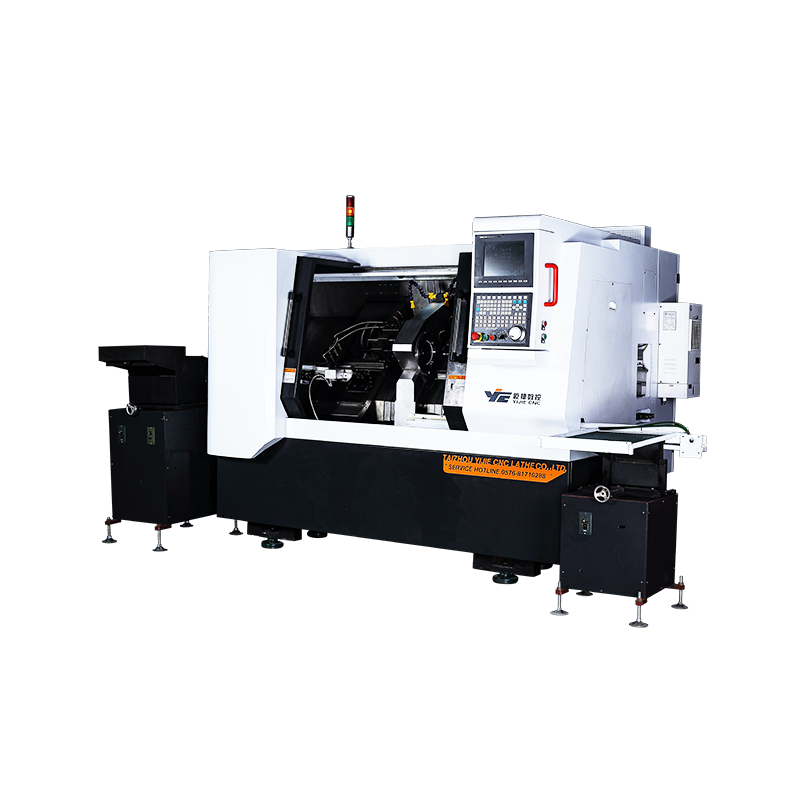
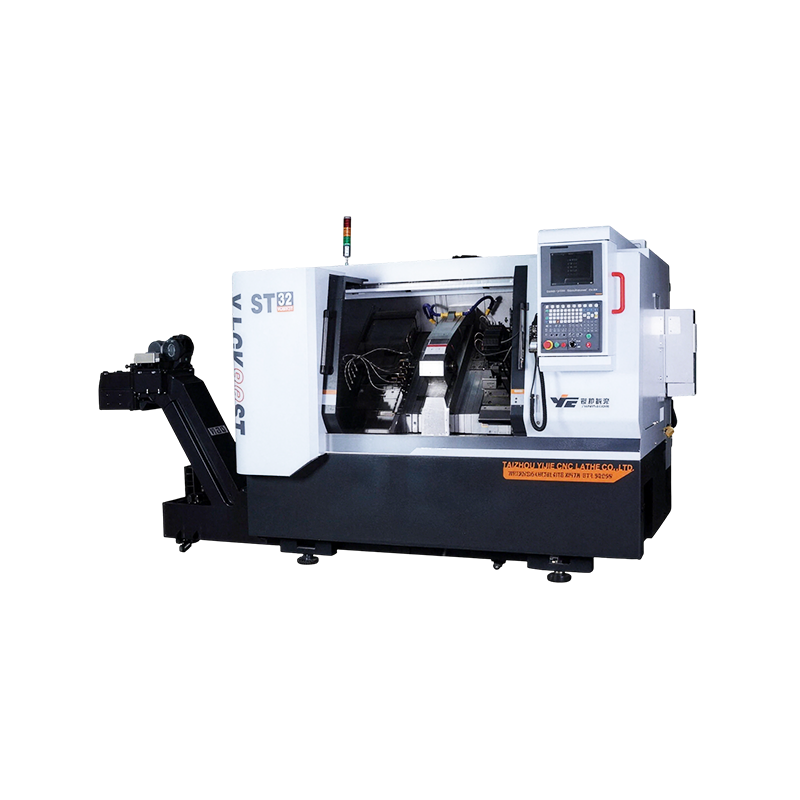
The YJ-CK50SDT opposed dual-spindle automated in-line system for disc-type parts has been developed to solve this problem. With a vertically movable dual-spindle design, both sides of the disc workpiece can be machined simultaneously. The system features a high level of intelligence, high precision, doubled production efficiency, and a footprint reduced by half.2. Features.
Fully Automatic Compound Machining Process Design
By combining upright and inverted turning, the machining of disc-type parts is integrated into a two-in-one process. This enables simultaneous four-axis machining on both ends. Together with the automatic loading and unloading module, TrackMotion automation module, and the modular machine structure, the entire process is fully automated and unmanned. This eliminates errors caused by repeated manual clamping, ensures machining accuracy, reduces auxiliary time, and doubles production efficiency.
Integrated Opposed Dual-Spindle Design
The dual spindles are arranged in an opposed vertical layout. The upper spindle picks up the workpiece from the loading device and completes the bottom-face turning operation. The workpiece is then transferred to the lower spindle with stable and accurate positioning by the upper spindle. The lower spindle, in cooperation with the tool turret, completes the machining of the top face.
Workpiece reversing and transfer are accomplished between the two spindles without the need for any additional mechanical devices, ensuring greater stability. This design eliminates manual flipping and reclamping, offering high machining accuracy, high efficiency, and a compact footprint.
Vertical Storage and Conveying System Design
Traditional workpiece loading relies on manual handling, which is labor-intensive and inefficient. The YJ-CK50SDT adopts a vertical storage and conveying system. The storage bin is equipped with multiple circumferential guide rods, allowing workpieces to be stacked neatly via tipping guide rods. Through motor indexing and equal-interval timing control, workpieces are accurately conveyed to the pick-up position of the upper spindle chuck.
This vertical storage design increases storage capacity per unit floor space, reduces labor intensity, and enables large-batch automated machining.

 English
 中文简体
中文简体 русский